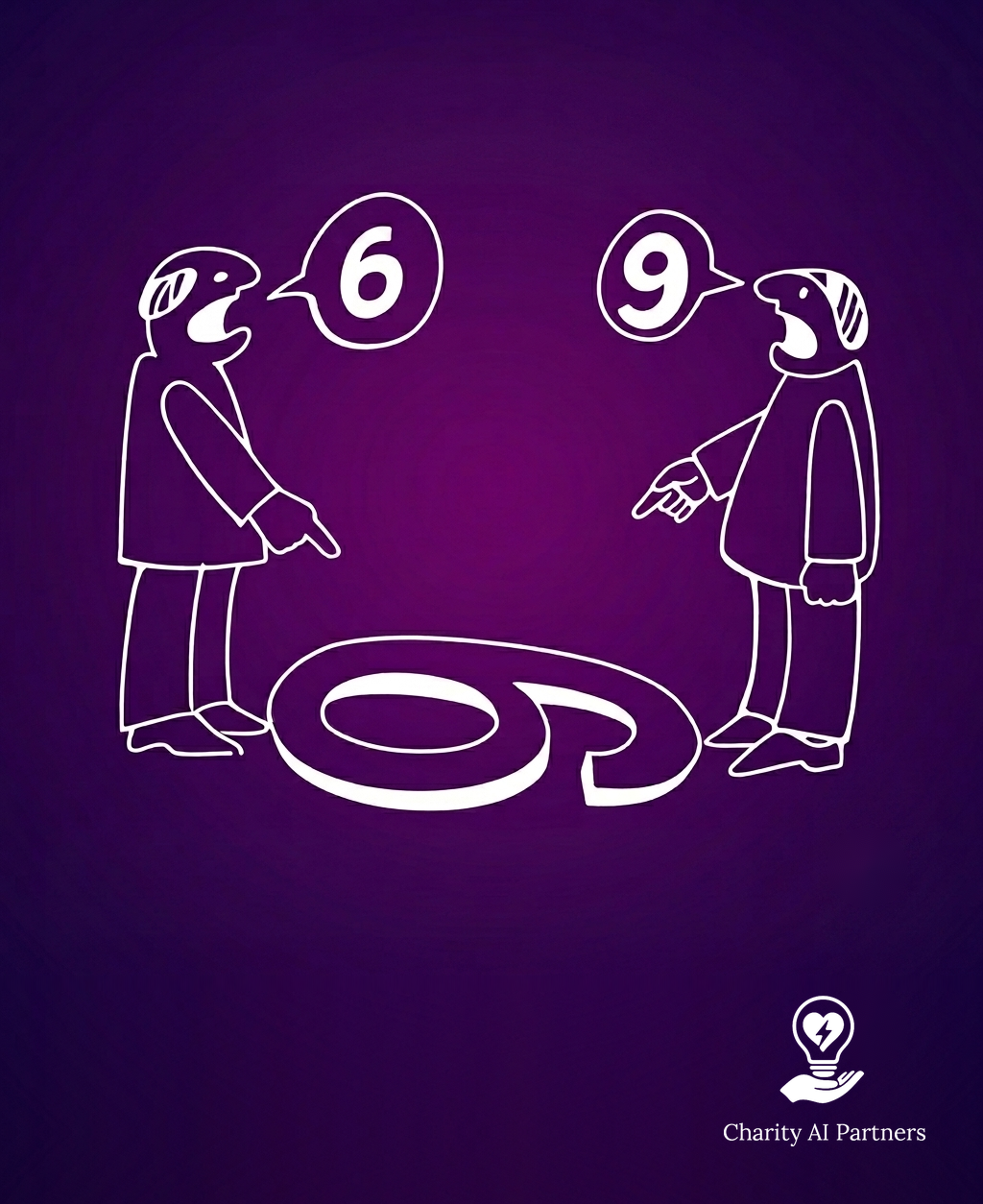
Whether it’s the PM, the football, or AI in your charity, we all have our own perspective. I’ve always loved this image, which sums up, elegantly and simply, how human disagreements and dialogue play out. One person sees a six. The other, standing somewhere different, sees a nine.
I keep hearing from leaders in the charities we work with that AI is divisive.
- Will it deliver real results?
- How will we measure the cost and the return?
- Will it take my job?
Perhaps a few forward-thinking early adopters can see how transformative it could be for your charity, while others are more resistant or fear negative repercussions.
What sets in is decision paralysis.
Endless working groups that seem to echo the last, trustee meetings that kick the “AI” as an agenda item into the next month (citing they need more hard data on the safeguards and ROI) and CEOs who have more pressing and urgent matters. AI is important, but it doesn’t yet feel urgent.
Meanwhile, other charities are seeing Direct Mail income increase 400%.
So why the delay in our sector?
The biggest barriers to AI adoption are human concerns, not technical challenges.
Here are some of the reasons why AI is not being embraced as it could be, and why charities are missing out:
Charity leaders are naturally and instinctively:
🫶 People Protectors
They worry AI is a “Job Eater” that will consume staff roles, dampen volunteer engagement, and remove the human touch in beneficiary interactions.
Not so… AI can and should be used to free staff for supporter-facing work.
🫸 Late Adopters
Budgets are always under pressure, most charities lack the specialised technical background knowledge and skills, and they can struggle to train teams on new systems.
But… AI is game changing. For instance, 7 out of 10 web searches are now summarised by AI. You’ve seen the AI summary at the top of Google. These people are no longer visiting your site. Your biggest shop window is shattered, and the door is jammed for potential new supporters. AI is reshaping and transforming every sector. In this case, charities have more to gain from AI, to free up precious resources and help more people. We also have a moral imperative. As charity leaders, progress is always our prerogative, since the work we do is so life changing.
⚖️ Risk Reducers
Hesitation is the MO for charities. Not without reason: reputation really matters. So, concerns around data privacy or bad press can slow trustees and exec teams down.
Yet… the EU’s new AI rules start to bite this summer, and the EU’s reach does not stop at its border. If any of your supporters, or their data, sit inside the EU, those rules can apply to your charity too.
🕊️ Ethical Champions
We actually care in our sector. That’s why you work in a charity. Some charities have ethical questions regarding AI’s societal impact (for instance in the realm of chatbot counselling).
However… engaging with this opportunity literally gives you the chance to shape it, and make it work safely and ethically for everyone you work with.
The conversation around AI and the charity sector is only just beginning, but it’s moving fast.
If you’d like some help facilitating exec or trustee-level conversations, so you get the big calls right, do reach out. I work with trustees, CEOs, c-suite leaders, and Fundraising Directors. And I can help you make the case inside your charity, if you’re facing a sceptical or worried board.
Sources. 7 in 10 web searches summarised by AI: Similarweb, “Google Zero-Click Search”. 400% Direct Mail uplift: a UK hospital charity using predictive AI to choose and segment recipients and to personalise the ask amount, taking a 2:1 return up to a 6:1 return.
Darren Richards is the founder of Charity AI Partners and the ‘Charity AI Guy’. He is the author of The Plane Parable and host of the Someday Arrival podcast. @CharityAIGuy